










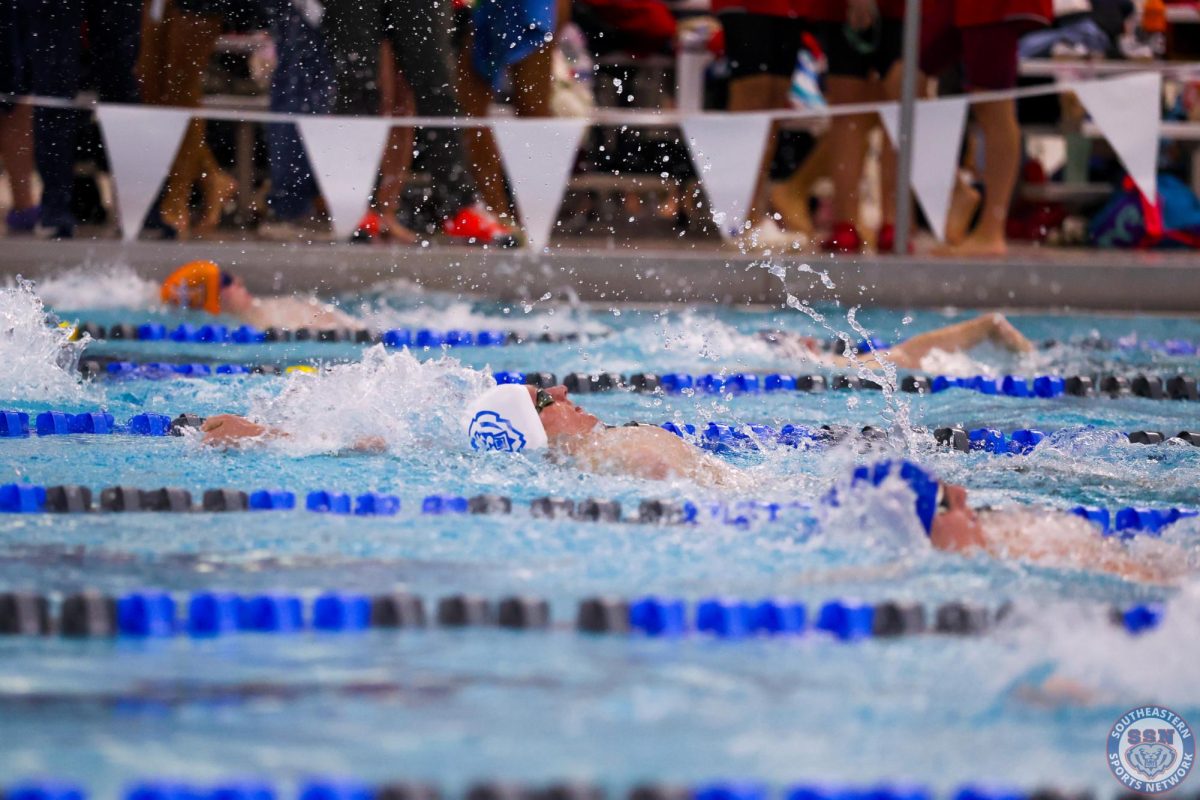
For the majority of swimmers, the race doesn’t end at the wall — it ends at the clock.
“When I finish a race, I usually look at the clock first because I want to see how I did in that race,” junior Jagger Chan said.
In swimming, the clock isn’t just a piece of decoration on the wall. For swimmers, it’s everything. There are no referees debating calls and no subjective scores. Every performance is measured down to the hundredth of a second. Whether it’s practice on a Wednesday afternoon or a sectional final, time determines success. Despite the seemingly standard clock across different competition sites, Chan emphasizes the difference in feeling between them.
“During practice, the clock does not add much pressure at all since we are all tired and obviously aren’t going to perform our best,” Chan explained.
He continues to explain that dual meets often feel very similar.
“They are right in the middle of our training schedule in the week, so people aren’t going to go as fast as they possibly can, and the only priority is beating out opposing swimmers,” Chan said.
In the middle of the season, swimmers expect to be exhausted. Heavy training loads mean times often go up instead of down. For athletes who tie progress to numbers, it can be frustrating.
“The clock can definitely mess with confidence over the season because obviously you’re going to add time throughout the season because of the training schedule,” Chan said. “With all the added times, a lot of people wonder what the point of their hard work is. But at the end of our season, after we taper, times will drop significantly.”
The process of building fatigue before cutting back for higher-consequence meets requires trust. Coaches understand this. Swimmers tend to struggle with it.
“Coaches act more maturely about times because they know the whole process and the fact that you will add time throughout the season,” Chan said. “However, swimmers might act more emotionally because they don’t understand the whole process of training and when you are supposed to drop time.”
Championship meets, however, bring a completely different level of intensity.
“During championship meets, such as the upcoming sectional and state meets, the clock adds much more pressure because you aren’t only competing for first to get to state, but you’re also trying your hardest to get a time that will help you get pulled into the state meet if you didn’t win your sectional,” Chan explained.
At that point, swimmers aren’t just racing competitors — they are racing qualifying standards. Still, time isn’t the only measure of success.
“Yes, I’ve felt proud of a race even though I added time,” Chan said. “It was during Mudsock, and I beat my rival from Fishers in all of our events, which made me proud.”
Moments like that show the emotional side of the sport. Even in a competition defined by numbers, rivalry, grit, and effort matter. But the mental challenges never disappear. Chan believes many swimmers connect their identity to their performance.
“I think a lot of swimmers tie their self-worth to their times just because the whole sport is a comparison of your times against everyone else’s, including your teammates,” Chan continued.
That constant comparison can make even simple practices feel much more intense. Without the rush of a meet — no crowd noise, no competitors in the next lane — it’s just him, the water, and the pace clock staring back. Morning practices start before the sun is fully up, and by the time he’s racing the clock, his body is already tired. The repetition can blur together: lap after lap, interval after interval, trying to hit the same number again and again without letting his focus slip.
Even without spectators, the clock still dictates everything. Every set, every drill, every breath is calculated with one goal in mind — cutting time as much as possible. In swimming, improvement isn’t dramatic. It’s microscopic. A fingertip’s difference on the wall can define a season.
That wasn’t always how Chan saw it. When he was younger, the sport felt more demanding than rewarding. The early mornings and endless laps made it hard to care about times at all. But as he grew stronger and started dropping seconds, his mindset shifted. The numbers on the board began to matter. He found himself thinking about splits, finishes, and tiny technical details long after practice ended. What once felt exhausting became something he was invested in.
For swimmers like Chan, the clock is both fuel and weight. It can validate months of work or magnify a single mistake.